History of Establishment
Social and Cultural History
Thidanad Gram Panchayat is situated in Meenachil Taluk of Kottayam District, under the Erattupetta Block, and includes Kondoor Village. The Panchayat has an area of 37.19 square kilometres. It is bounded by Erattupetta, Bharananganam and Thalappalam Panchayats in the north; Poonjar, Erattupetta and Parathodu Panchayats in the east; Parathodu and Kanjirappally Panchayats in the south; and Elikkulam and Meenachil Panchayats in the west.
Surrounded by hills on all four sides, the Panchayat lies in a low-lying valley-like region between the hills. It is believed that the area came to be known as “Thidanad” because of this geographical feature. According to the historical account of Thidanad Mahadeva Temple written by Sri. N. Parameswaran Moosath, the region was originally known as “Thadanad”. Thiruvudayar Swami, a revered spiritual leader who arrived in this region, is believed to have constructed a Vaishnava temple adjacent to the existing Mahadeva Temple. Over time, Thadanad came to be known as Thiruvudayarnad, which gradually evolved into Thiruvudanad and eventually into Thidanad.
It is believed that around forty Brahmin families lived in this region several centuries ago. During that period, a group of Vaishyas, also known as Chettiyars, left Madurai along with their wealth following a dispute with the representatives of the King of Madurai and eventually settled in this area. One of the Swamis who led the group was Thiruvudayar Swami. While some of his followers settled in Thadanad along with him, another group, under the leadership of Kondudayar Swami, settled at a nearby place. It is believed that the place where they established their settlement came to be known as Kondoor. Another group settled elsewhere under the leadership of Chotudayar Swami, and that place is believed to have acquired the name Chothuthodu based on the name of Chotudayar Swami.
The administration of the region during those days is believed to have been carried out by local chieftains who maintained close relationships with the temples and also functioned as judicial authorities. An inscription found on a bell at Thidanad Mahadeva Temple provides evidence supporting this assumption. The inscription states that the bell was hung at the western entrance of the temple as an act of penance by Narayanamangalath Vikraman Vikraman for having permitted Panachel Panikkar to be punished by hanging for an offence involving one hundred new coins. This also indicates that non-Brahmin communities lived in the region during that period.
Apart from the historical references mentioned above, no other substantial historical records relating to these early periods are presently available. Until about a century ago, areas such as Vengathanam, Karimpanoli and Madamketti in the Panchayat formed part of privately owned forests, while the remaining areas were largely agricultural lands. Land ownership at that time was mostly concentrated in the hands of landlords. They leased out their lands orally to tenants for cultivation, often under traditional arrangements such as “Kilachapathi”. As a result, many people took up agriculture as their livelihood.
The Christian population of the region, except those who migrated from other places, consisted largely of people who had converted from Hinduism. Later, many people moved from the Catholic Church to the CMS Church. Social discrimination, untouchability and the exclusion practised by the upper sections of their own community were among the major reasons for this change. The landlords of that period were often known for their harsh treatment. The protection provided to those who joined the CMS Church also attracted many people to the denomination.
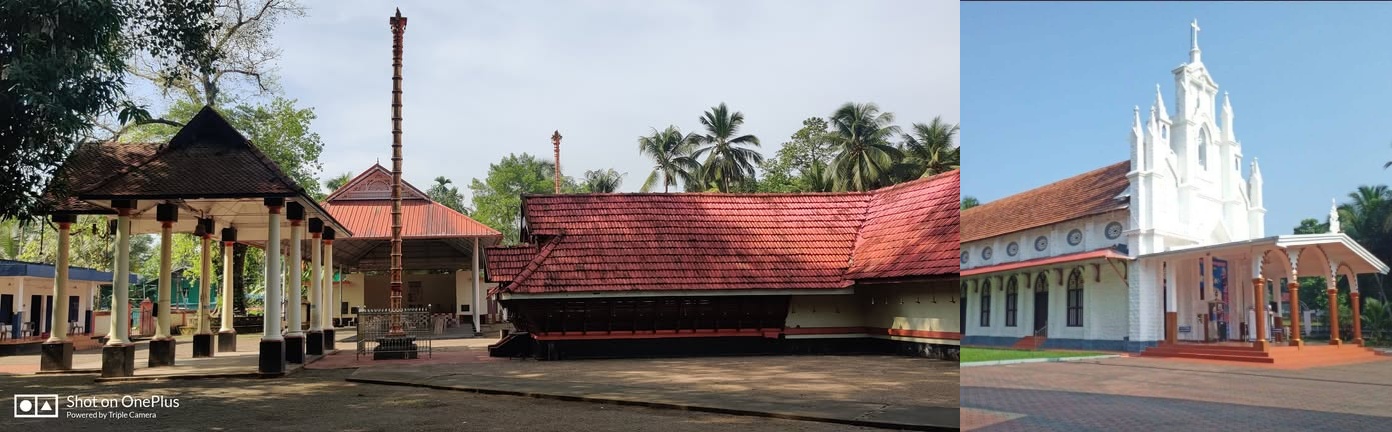
Until about two centuries ago, temples were the central focus of social life in the region. Thidanad Mahadeva Temple is considered the oldest place of worship in the area. Since it is a Shiva temple, it can be assumed that Shaivite traditions were prominent among the people living here during that period. To the north of this temple, Thiruvudayar Swami, following a vision he is believed to have received in a dream, constructed another temple with the cooperation of the local people. The temple has an idol of Narasimha Murthy facing west and an idol of Lord Krishna facing east. Rituals such as sandalwood paste decoration, Jaladhara and Karpura Uzhichil, which are believed to have been initiated on the instructions of the Swami, continue to be observed even today.
Among the major festivals associated with Thidanad Mahadeva Temple, the Shivaratri festival is the most important. The festival begins with the hoisting of the temple flag on the day of Chothi and continues for nine days. In earlier times, many devotees travelling to Sabarimala used to visit this temple, offer prayers and rest here before continuing their pilgrimage to Sabarimala.
Today, a significant proportion of the population of the Panchayat consists of Hindus and Christians, along with a small Muslim minority. The oldest Christian place of worship in the Panchayat is St. Joseph's Church, which was elevated to the status of a parish church on 16 January 1895. Until then, the Christians of this region depended mainly on the churches at Aruvithura and Anakallu. Before being elevated to a parish church, Thidanad Church functioned as a chapel under Aruvithura Church. The foundation stone of the present church was laid on 23 January 1865, and its construction was completed and the church was blessed on 22 January 1877. On 23 January, Rev. Valiyaveettil Itticherian Achen celebrated the first Holy Mass in the church.
With the growth of the Christian population, St. John's Church at Ambaranirappel was established in 1917, the Church of the Twelve Apostles at Chemmalamattam in 1922, and Fatima Matha Church at Chettuthodu in 1953.
Kondoor Sree Krishna Swamy Temple is also considered to be as old as Thidanad Mahadeva Temple. Padippuraykkal Mathangi Bhagavathy Temple, the family temple of the Padippuraykkal family, and Kaippallikkavu, belonging to Kaippally Illam, are other important places of worship within the Panchayat.
From 1910 onwards, for a considerable period, a primary school functioned under the management of St. Joseph's Church, Thidanad, with a government grant. In addition to the grant, parishioners contributed one rupee per household as “Kettuthengu” and one Idangazhi of rice every month towards the salaries of teachers. In the Malayalam Era 1093, the Thidanad Sanmarga Darshini Hindu Samajam began functioning. At that time, people belonging to different Hindu communities were members of the organisation. In 1942, following the call of Sri. T. K. Madhavan, an SNDP branch began functioning in the area.
During the first decades of the twentieth century, the only motorable road in the Panchayat was the Erattupetta–Kanjirappally road. Agricultural products from the region were transported to market centres such as Alappuzha and Athirampuzha, while essential goods required in the area were brought by boat through the Chittar River. In the absence of established shops, there was also a practice of transporting goods by boat and selling them from place to place. At the beginning of the 1930s, a public market began functioning in the present-day Thidanad town for the buying and selling of goods. The present Thidanad town developed gradually from this market.
The principal means of livelihood of the people during those days were agriculture and animal husbandry. Cash crops such as coconut, paddy, arecanut, coffee, tea and pepper; food crops such as tapioca, yam, colocasia and lesser yam; and spices such as ginger, turmeric, clove and nutmeg were cultivated extensively. Dry-land paddy cultivation was also widespread in the region. Traditional agricultural practices dependent on climatic conditions were followed.
Neighbouring families used to work together and support one another in labour-intensive agricultural activities. Tasks such as weeding, sowing and house construction were often carried out collectively. The system of “Mattachal Pani”, in which families reciprocated by working on each other's land according to the number of working days contributed, was prevalent. Animal husbandry was an integral part of agricultural life. Since the population was comparatively small, the extensive open spaces and grasslands available at the time provided suitable conditions for raising cattle.
The first formal educational institution established in Thidanad Panchayat was the Thidanad Government Lower Primary School, founded in 1915. It was upgraded to an Upper Primary School in 1949 and to a High School in 1974. In 1984, vocationally oriented courses were also introduced there.
Around the same period when Thidanad Primary School was established, St. John's Lower Primary School was founded in association with Ambaranirappel Church. In 1916, St. Sebastian's Lower Primary School was established at Pathazhabhagam, and in 1977, St. George Lower Primary School was established at Vayilukanampara. In one sense, the Poonnakanad CMS LP School can claim to be the earliest school in the Panchayat. Although it began functioning as a recognised school in 1930, the school records indicate that a small traditional school had already been functioning under the auspices of the CMS Church as early as 1887.
Chemmalamattam Little Flower School began functioning as a primary school in 1926 and was upgraded to an Upper Primary School in 1979 and a High School in 1983. Chettuthodu St. Joseph's LP School began functioning in 1966. Thus, educational institutions had started functioning in most parts of the Panchayat during the early decades of the twentieth century. Before that, people depended mainly on traditional “Asan Kalari” schools and village schools for education.
Rubber cultivation, which played a major role in improving the economic condition of the people, became popular in this region in the early 1930s. During this period, foreigners established rubber estates in places such as Mundakayam and Teekoy. As rubber cultivation expanded, farmers gradually shifted away from other crops, and rubber became the principal agricultural crop of the Panchayat. According to the book “Poonjar – Where History Sleeps” by Sri. Mathew Mannarakath, the wage for tapping 100 rubber trees was four annas, agricultural labourers were paid six annas, and carpenters and masons received eight annas per day during that period.
An Extra Departmental Branch Post Office was established at Thidanad in 1954. Two cinema theatres had functioned in the Panchayat area in the past, but both eventually ceased operations. At a time when television, radio and other modern means of entertainment were not available, temple festivals and church feasts were the major cultural events of the people. Many people were skilled in traditional folk arts such as Kurathiyattam, Villodichan Pattu and Thiruvathirakali. Numerous drama and dance troupes performed during temple festivals and church feasts. Professional drama troupes that earned fame through performances on various stages were a source of pride for Thidanad.
Agricultural activities such as Poondankala and Thengavettu, as well as house construction and wedding celebrations, were transformed into occasions for collective participation, with neighbours coming together to celebrate and support one another. Such collective activities not only reduced the burden of work but also strengthened the spirit of cooperation among the people and helped eliminate social distance.
Even today, most of the more than 70 kilometres of roads in the Panchayat have been constructed through collective efforts and voluntary labour by the people. However, compared with the past, a decline in the spirit of mutual cooperation and collective participation can now be observed.
In 1928, Sri. Varkey Joseph Vellookunnel was elected as the representative of Meenachil Taluk to the Sreemoolam Popular Assembly, and in 1931, Sri. Varkey Chacko Vellookunnel was elected to the same body. Although the spirit of the freedom struggle against British rule had spread among the people of the Panchayat, most of whom were engaged in agriculture, no prominent freedom fighters emerged from the region. However, several young people from the area boycotted schools and joined the freedom movement. Their active participation brought a new awakening to the social and cultural life of Thidanad Panchayat.
Thidanad Panchayat has a rich and diverse cultural heritage. The population consists predominantly of Hindus and Christians, with a small number of Muslim families. The ancient Thidanad Mahadeva Temple and the historic St. Joseph's Church are among the most important religious and cultural landmarks of the Panchayat.
The first elected administrative committee of Thidanad Panchayat came into existence on 15 August 1953. At that time, Erattupetta Panchayat had not yet been formed, and the territorial extent of Thidanad Panchayat was much larger than it is today. The area extending southwards from the locality where Aruvithura St. George's High School is currently situated was also part of Thidanad Panchayat. Sri. V. C. Devassy Chittappanattu was elected as the President and Sri. R. Narayana Pillai as the Vice-President.
The social and cultural life of Thidanad Panchayat was enriched by traditional folk arts such as Kurathiyattam, Garudan Parava, Koladikali and Villadichan Pattu. The village of Thidanad therefore possesses a long and remarkable cultural heritage deeply rooted in history. Surrounded by hills on all four sides and situated in a low-lying valley-like region, the area came to be known as “Thidanad”, a name that reflects its distinctive geographical character and its ancient historical identity.